Golf Club Lofts by Club: Full Chart
Golf club lofts by club, in one chart: typical driver, fairway wood, hybrid, iron and wedge lofts — and why two sets with the same numbers can differ.

Golf club lofts run from around 8 to 12 degrees on a driver up to 58 to 64 degrees on a lob wedge, with every other club stepping between them. Loft is the angle of the clubface relative to vertical, and it is the single biggest reason each club flies a different height and distance. The catch: lofts are not standardized, and modern sets are often several degrees stronger than older ones, so the chart below shows typical ranges — the loft of your club is whatever is stamped on it or printed in its spec sheet.
This page is a reference for the whole bag. It covers the typical loft of every club from driver to lob wedge, why the same number iron can differ by a full club between manufacturers, how big the gaps between clubs should be, and how to find your real distances for each loft instead of guessing.
- Driver — typically about 8 to 12 degrees; 10.5 is a common choice.
- Fairway woods — 3-wood about 13 to 16 degrees, 5-wood about 17 to 19, 7-wood about 20 to 22.
- Hybrids — typically about 17 to 27 degrees depending on the number.
- Irons — from roughly 20 to 25 degrees (4-iron) up to roughly 37 to 43 degrees (9-iron).
- Wedges — pitching about 44 to 48, gap 50 to 52, sand 54 to 58, lob 58 to 64 degrees.
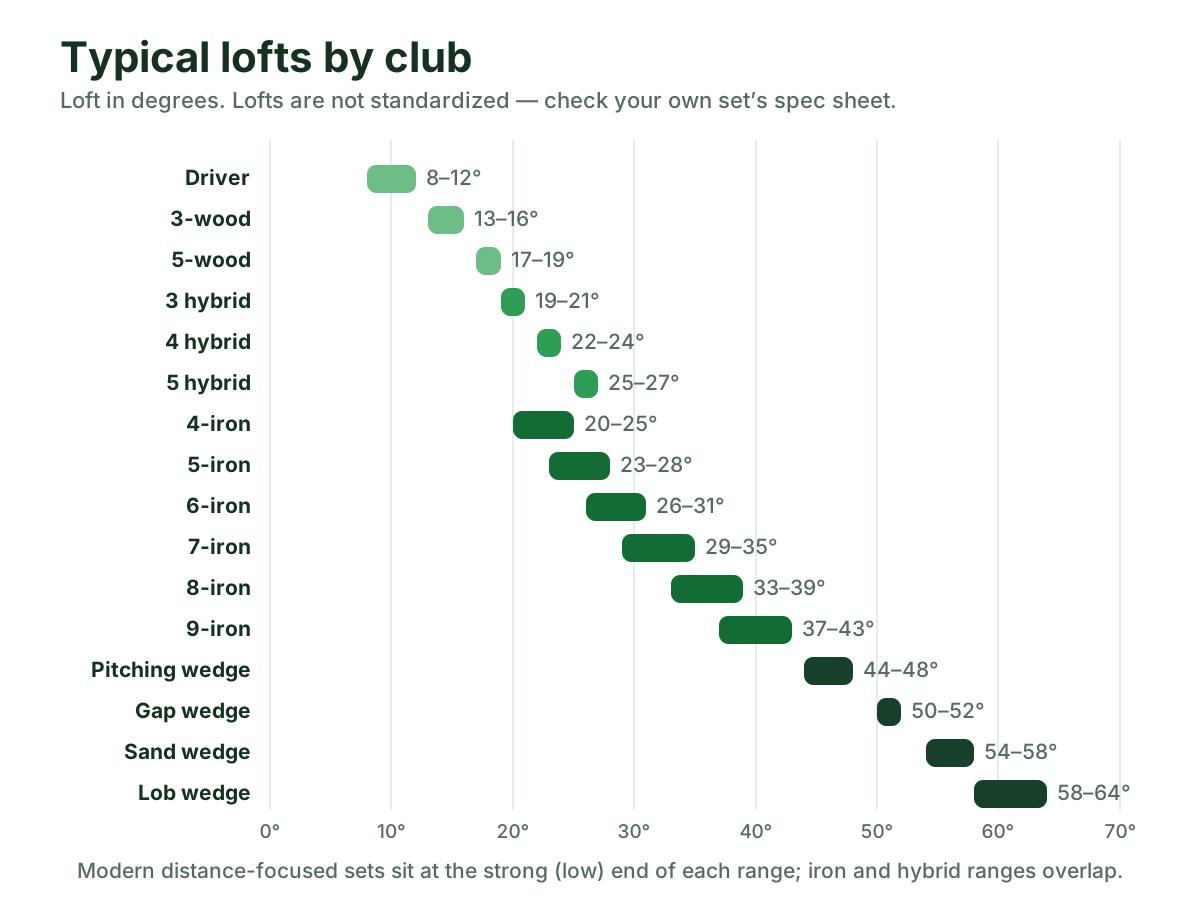
What are typical golf club lofts by club?
Working through the bag: drivers usually run 8 to 12 degrees, with 10.5 a common all-round pick. Fairway woods step up from about 13 to 16 degrees for a 3-wood to about 20 to 22 for a 7-wood. Hybrids cover roughly 17 to 27 degrees — see what degree is a 3, 4 or 5 hybrid for how they map to irons. Irons climb in roughly 3- to 4-degree steps: a 4-iron is often 20 to 25 degrees, a 7-iron 29 to 35, a 9-iron 37 to 43. The wedges finish the ladder: pitching about 44 to 48, gap 50 to 52, sand 54 to 58 and lob 58 to 64. Every one of those ranges is indicative, not a rule.
Why do lofts vary so much between manufacturers?
Because the number on the sole is a label, not a measurement standard. Manufacturers set lofts to suit each model's job: distance-focused game-improvement irons use stronger lofts to launch lower and fly farther, while traditional and players irons keep weaker lofts for height and control. Over the years the whole market has drifted stronger, so a modern 7-iron may carry the loft an 8- or 9-iron had decades ago. That is why comparing two sets by club number alone is misleading — our strong vs weak lofted irons guide covers what to compare instead.
How much loft gap should there be between clubs?
Most golfers aim for gaps that produce even distance steps: typically about 3 to 4 degrees between irons and 4 to 6 degrees between wedges. At the long end, loft gaps are naturally bigger because small loft changes matter less than length and clubhead design. The places gaps most often go wrong are the top of the bag — where a 3-wood, hybrid and long iron can bunch together — and the bottom, where a strong pitching wedge leaves a hole before the sand wedge. Our club gapping guide explains how to audit the whole set.
Which lofts should beginners pay attention to?
Two spots matter most. First, driver loft: more loft is generally easier to launch, so newer players usually fare better at 10.5 degrees or higher rather than chasing the low lofts better players use. Second, the wedge gaps: if your set's pitching wedge is strong, make sure something fills the space before your sand wedge. In the middle of the bag, worry less about the printed numbers and more about whether each club flies a distinctly different distance.
How do you find your real distances for each loft?
The chart tells you the shape of a set, but only measurement tells you your distances. A launch monitor reports carry, height and spin for every club, which turns the loft ladder into a personal yardage chart and exposes any clubs doing duplicate work. Our metrics guide explains the key numbers, and you can find a simulator near you to map your own bag in a single session.
Ready to turn lofts into yardages? Find an indoor golf simulator near you, read up on launch monitor metrics, or dive into a wedge with what degree is a pitching wedge.