Strong vs Weak Lofted Irons
Strong vs weak lofted irons explained: why one 7-iron flies farther than another, what stronger lofts really change, and how to compare sets fairly.

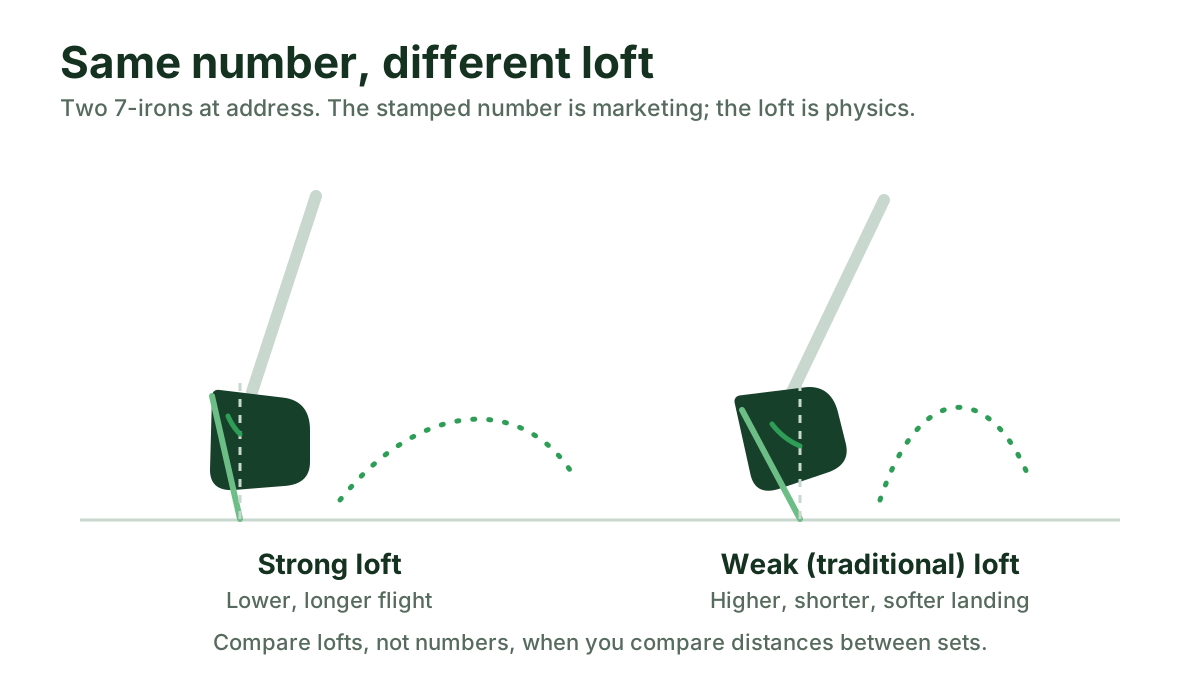
Strong lofted irons have less loft than traditional irons carrying the same number — a strong 7-iron might have the loft a 6-iron (or even a 5-iron) had a generation ago, so it launches lower and flies farther. Weak (or traditional) lofts keep more angle on the face for a higher, softer flight. Neither is wrong: they are different design philosophies. But the difference explains one of golf's most common arguments — why your 7-iron goes farther, or shorter, than your friend's.
The club number on the sole feels like a standard, and it is not. This guide explains what strong lofts are, why the same number iron flies wildly different distances between sets, whether stronger lofts genuinely add useful distance, and how to compare two sets honestly — by loft and measured carry rather than by the number printed on the club.
- Strong lofts = less loft per club number; weak or traditional lofts = more.
- Iron lofts have drifted stronger across the market over the years.
- Two 7-irons can differ by 5 degrees or more — a full club of distance.
- Stronger lofts fly farther but launch lower and can be harder to stop on greens.
- Compare stamped lofts and measured carries, never club numbers.
What are strong lofted irons?
Strong simply means less loft than the traditional norm for that club number. Distance-focused game-improvement sets are the usual home of strong lofts: the designers lower the loft, then use deep, low centres of gravity and fast faces to keep the ball airborne despite it. Players and traditional sets keep weaker lofts because their buyers value flight height, spin and stopping power over raw distance. Loft ranges for every club are in our golf club loft chart.
Why does the same number iron fly different distances?
Mostly because it is not the same club. If your 7-iron has several degrees less loft than your friend's, it behaves like his 6-iron — of course it goes farther. Add small differences in shaft length, head design and swing speed and the gap widens further. This is worth remembering whenever club-number comparisons come up: outdriving someone's 7-iron with yours says almost nothing if the lofts differ. The honest comparison is loft against loft, or better, measured carry against measured carry.
Do strong lofted irons actually add distance?
They add real distance per club number, and modern head design recovers much of the launch height that lower loft would otherwise cost. What they cannot do is add distance to your whole game for free: the bag still runs from your driver to your highest wedge, and making the middle clubs longer just moves the numbers around. The practical effects to watch are at the edges — a lower, hotter flight can be harder to stop on firm greens, and a strong pitching wedge opens a distance hole before your sand wedge that may need an extra gap wedge to fill.
What should you compare instead of the club number?
Three things. First, stamped loft — it is the closest thing to a like-for-like spec. Second, measured carry distance, because loft alone does not capture head design, shafts or your delivery. Third, flight and stopping behaviour: two clubs that carry the same distance can land very differently. If you are choosing between sets, hitting both on the same launch monitor in the same session is the fairest test available, and a club fitting adds a trained eye to the data.
How can a simulator settle the strong vs weak question?
A launch monitor removes the labels and shows the ball flight: carry, launch angle, height and spin rate for every club in either set. In one bay session you can map your current irons, spot the bunched or missing distances, and see whether a stronger or weaker set actually improves your gaps rather than just renumbering them. Our metrics guide explains each number, and you can find a simulator near you to run the comparison.
Want the real numbers? Find an indoor golf simulator near you, check the full loft chart, or read how to use simulator data to fix your swing.