What Degree Is a Sand Wedge?
What degree is a sand wedge? Most sand wedges are 54 to 58 degrees of loft, with 56 degrees the most common — here is how it fits with your other wedges.

What degree is a sand wedge? A sand wedge is typically 54 to 58 degrees of loft, and 56 degrees is the most common choice. Loft is the angle of the club face, and it is what makes a sand wedge fly high and land soft — ideal for bunkers and short shots around the green. The exact number varies a little by manufacturer and by the set it comes in, so it is always worth checking the number stamped on your own club.
Knowing your wedge lofts helps you build even distance gaps between clubs, so you are not left with awkward yardages. This guide covers the typical sand wedge loft, how it compares to the other wedges, how to check yours, and how a golf simulator or launch monitor makes it easy to learn exactly how far each wedge carries.
- A sand wedge is usually 54 to 58 degrees of loft, most commonly 56 degrees.
- Higher loft means a higher, shorter, softer-landing shot.
- Lofts vary by brand and set, so check the number stamped on the sole or hosel of your club.
- Wedges work best when the lofts are evenly spaced, usually about 4 to 6 degrees apart.
- A launch monitor or simulator shows your real carry distance for each wedge.
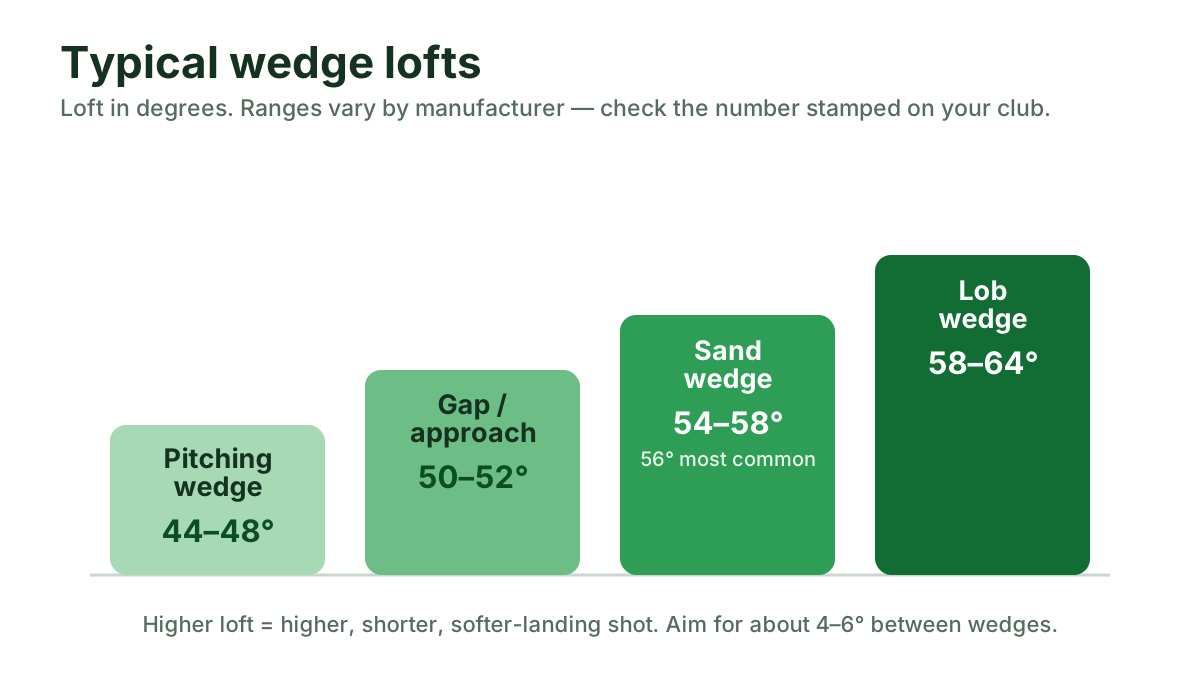
What is the typical loft of a sand wedge?
A sand wedge usually falls between 54 and 58 degrees, with 56 degrees the most common single loft. That loft is a balance: enough to lift the ball quickly out of sand and stop it on the green, but not so much that it becomes hard to control on longer shots. Because manufacturers set their lofts differently, two sand wedges labeled the same way can still differ slightly, so the safest way to know yours is to read the number printed on the club.
How does a sand wedge compare to other wedges?
A sand wedge sits between the gap wedge and the lob wedge in a typical set. Moving up in loft, the pitching wedge is usually around 44 to 48 degrees, the gap (or approach) wedge around 50 to 52, the sand wedge around 54 to 58, and the lob wedge around 58 to 64. Each step up in loft trades distance for height and stopping power, which is why most players carry two or three wedges to cover the short-range yardages.
- Pitching wedge — typically about 44 to 48 degrees.
- Gap / approach wedge — typically about 50 to 52 degrees.
- Sand wedge — typically about 54 to 58 degrees (56 is most common).
- Lob wedge — typically about 58 to 64 degrees.
Why is it called a sand wedge?
The name comes from its original job: escaping greenside bunkers. A sand wedge has a wide, angled sole with extra bounce — the way the sole is shaped so the club skims through sand rather than digging in. That same design also works well from soft turf and rough, which is why the sand wedge has become an all-purpose short-game club, not just a bunker tool.
How do you check the degree of your own sand wedge?
The quickest way is to look at the club itself: most wedges have the loft stamped on the sole or near the hosel, often as a two-digit number like 54, 56 or 58, sometimes alongside a bounce number. If nothing is marked, the manufacturer's website or the original spec sheet for your set will list it. A club fitter can also measure loft directly, which is useful if a club has been bent or adjusted over time.
How can a golf simulator help you dial in your wedges?
Loft tells you how a wedge should behave, but a golf simulator or launch monitor tells you how it actually performs for you. By hitting a series of shots indoors, you can see the real carry distance, launch angle and spin for each wedge, then space your lofts so the distance gaps are even. That turns the question of what degree your sand wedge is into the more useful one of how far you actually hit it. Our metrics guide explains those numbers, and you can find a simulator near you to test your own wedges.
Want to put the numbers to work? Find an indoor golf simulator near you, learn what a launch monitor measures, or read how to swing a golf club to build the technique behind those distances.