What Degree Is a 3, 4 or 5 Hybrid?
What degree is a 3, 4 or 5 hybrid? Typically about 19 to 21, 22 to 24 and 25 to 27 degrees. Here is how hybrids map to the irons they replace.

What degree is a hybrid? Typical ranges are about 19 to 21 degrees for a 3 hybrid, 22 to 24 for a 4 hybrid and 25 to 27 for a 5 hybrid, with 2 hybrids around 16 to 18 degrees. As with irons and wedges, there is no standard — each manufacturer numbers its hybrids to fit its own set design — so the loft printed on the club is the only number that travels between brands.
Hybrids exist to replace hard-to-hit long irons, which makes the loft question really a matching question: which iron does each hybrid stand in for, and why does a hybrid with the same loft fly differently anyway? This guide covers typical hybrid lofts, the usual iron equivalents, why the match is loose rather than exact, and how to confirm your own gaps on a launch monitor.
- 2 hybrid — typically about 16 to 18 degrees.
- 3 hybrid — typically about 19 to 21 degrees.
- 4 hybrid — typically about 22 to 24 degrees.
- 5 hybrid — typically about 25 to 27 degrees.
- A hybrid usually flies higher and carries a little farther than an iron of the same loft.
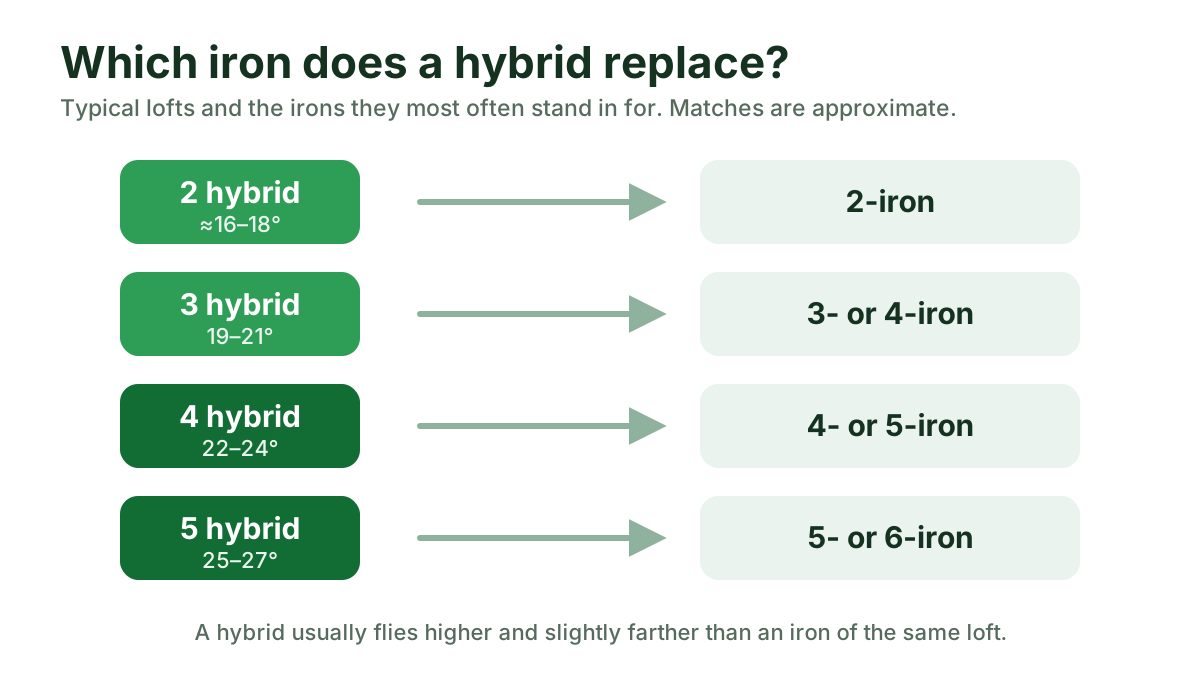
What are typical 3, 4 and 5 hybrid lofts?
Most 3 hybrids sit around 19 to 21 degrees, 4 hybrids around 22 to 24, and 5 hybrids around 25 to 27, with 2 hybrids in the 16 to 18 range. Some manufacturers print only the loft and skip the number entirely, which is arguably more honest — a 21-degree hybrid from one brand and a 3 hybrid from another can be the same club. Where the whole bag's lofts fall is covered in our golf club loft chart; the useful habit is reading the degree stamp, not the number.
Which iron does each hybrid replace?
The loose convention: a 3 hybrid stands in for a 3- or 4-iron, a 4 hybrid for a 4- or 5-iron, and a 5 hybrid for a 5- or 6-iron. The overlap exists because iron lofts vary so much between sets — if your irons are strongly lofted, a hybrid one number higher often matches better than the same number. The cleaner method is to match by loft: find the loft of the iron you are removing and pick a hybrid within a degree or two of it, then adjust from measured carry.
Why does a hybrid fly differently from an iron of the same loft?
Because loft is only one ingredient. A hybrid's head is deeper from face to back, which places the centre of gravity lower and farther from the face — that launches the ball higher and with more forgiveness than a long iron of identical loft. Hybrid shafts also tend to run slightly longer, adding a little speed. The practical result: most golfers hit a hybrid higher, straighter and a touch farther than the iron it replaces, which is the whole point — but it also means a like-for-like loft swap can leave you with a small distance overlap to check.
How do you choose which hybrids to carry?
Start from the longest iron you hit well, not from a formula. If that is your 5-iron, hybrids can cover everything above it up to your fairway woods; if you strike long irons cleanly, you may only want one hybrid, or none. Watch the top-of-bag bunching — a 3-wood, a strong 3 hybrid and a strong 4-iron can end up carrying nearly the same distance. Aim for clearly separated carries, and fill from there. Our club gapping guide covers the method end to end.
How can a simulator confirm your hybrid gaps?
Long clubs are where guessed yardages go to die — carry and total distance diverge, and headwinds flatter no one. A launch monitor shows the carry, height and spin for each hybrid and long iron side by side, so you can see whether the hybrid you bought actually fills the hole it was meant to. Our metrics guide explains the numbers, and you can find a simulator near you to test your setup in a single session.
Building the top of your bag? Find an indoor golf simulator near you to measure your gaps, browse the full loft chart, or read strong vs weak lofted irons to see why the numbers drift.