What Degree Is a Pitching Wedge?
What degree is a pitching wedge? Most pitching wedges are 44 to 48 degrees of loft, with modern sets at the stronger end. Here is how yours fits.

What degree is a pitching wedge? A pitching wedge is typically 44 to 48 degrees of loft, which makes it the lowest-lofted wedge in the bag and the bridge between your irons and your scoring clubs. Modern game-improvement sets sit at the stronger end of that range — some even dip below it — while older or more traditional sets sit closer to 47 or 48 degrees. Lofts are not standardized, so the surest answer for your own club is the number stamped on it or the manufacturer's spec sheet.
Because pitching wedge lofts have drifted stronger over the years, the club you call a pitching wedge may be several degrees different from your playing partner's — which is why two golfers can hit their pitching wedges very different distances. This guide covers the typical range, why it varies so much between sets, how the pitching wedge fits with the gap, sand and lob wedges, and how to check the distance gap it leaves in your set.
- A pitching wedge is usually 44 to 48 degrees of loft.
- Modern sets run stronger (less loft) than older or traditional ones.
- It is the lowest-lofted wedge, sitting between the 9-iron and the gap wedge.
- A stronger pitching wedge widens the hole to the sand wedge — that is the gap the gap wedge fills.
- A launch monitor shows your real carry distances so you can check the gaps yourself.
What is the typical loft of a pitching wedge?
A pitching wedge usually falls between 44 and 48 degrees. Unlike the other wedges, it almost always comes as part of your iron set rather than being bought separately, so its loft follows the design of that set. Traditional and players sets tend toward 46 to 48 degrees, while distance-focused game-improvement sets are often 44 to 45 degrees, and a few go stronger still. Because there is no standard, the only way to know your own loft for certain is to read the stamp on the club or look up the set's spec sheet.
Why do pitching wedge lofts vary between sets?
The main reason is that iron lofts across the whole set have been made progressively stronger over the years — often called loft jacking — so the pitching wedge has been pulled along with them. A stronger loft launches lower and flies farther, which makes a set look longer club-for-club. There is nothing wrong with that on its own, but it means the club number tells you less than it used to. Our guide to strong vs weak lofted irons explains what stronger lofts really change and what to compare instead.
How does a pitching wedge fit with the other wedges?
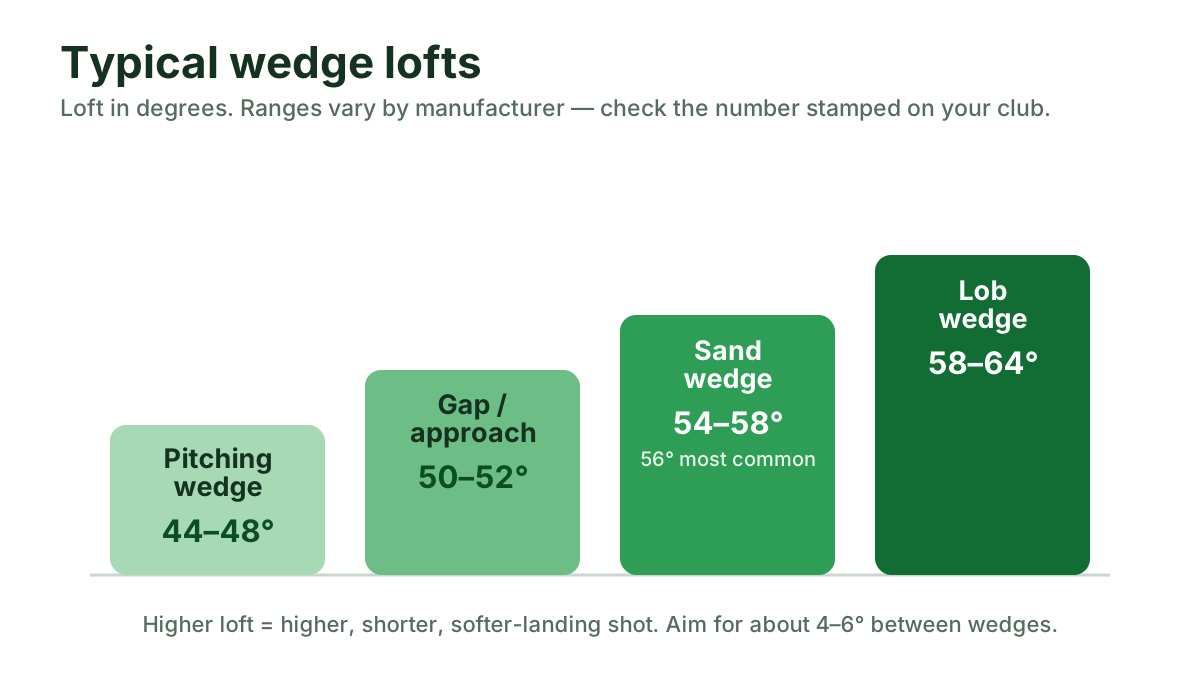
The pitching wedge opens the wedge ladder: it has the least loft, flies the farthest and rolls out the most. Above it sit the gap (or approach) wedge, the sand wedge and, for some players, a lob wedge, each adding loft for a higher, shorter, softer-landing shot.
- Pitching wedge — typically about 44 to 48 degrees.
- Gap / approach wedge — typically about 50 to 52 degrees.
- Sand wedge — typically about 54 to 58 degrees.
- Lob wedge — typically about 58 to 64 degrees.
What loft gap should you leave after your pitching wedge?
A common rule of thumb is 4 to 6 degrees between neighbouring wedges, which usually translates to a comfortable, even step down in distance. The catch is that the stronger your pitching wedge, the bigger the hole between it and a 54- to 56-degree sand wedge — a 44-degree pitching wedge leaves a gap of 10 degrees or more, which is too much for one club to cover. That is exactly why the gap wedge exists. Start from your pitching wedge's actual loft, then space the rest of your wedges from there; our club gapping guide walks through the whole process.
How can a golf simulator help you check your pitching wedge?
A stamped loft predicts distance; it does not measure it. Hitting a handful of shots with your 9-iron, pitching wedge and gap wedge on a launch monitor shows the real carry for each, so you can see whether the yardages step down evenly or whether two clubs are doing the same job. Our metrics guide explains the numbers to watch, and you can find a simulator near you to measure your own set.
Want to see your real wedge yardages? Find an indoor golf simulator near you, scan the full golf club loft chart, or read what degree is a gap wedge to complete the picture.