How Does Trackman Work?
A plain-English look at how Trackman uses radar to track your club and ball, and how that turns your real swing into a shot on the simulator screen.
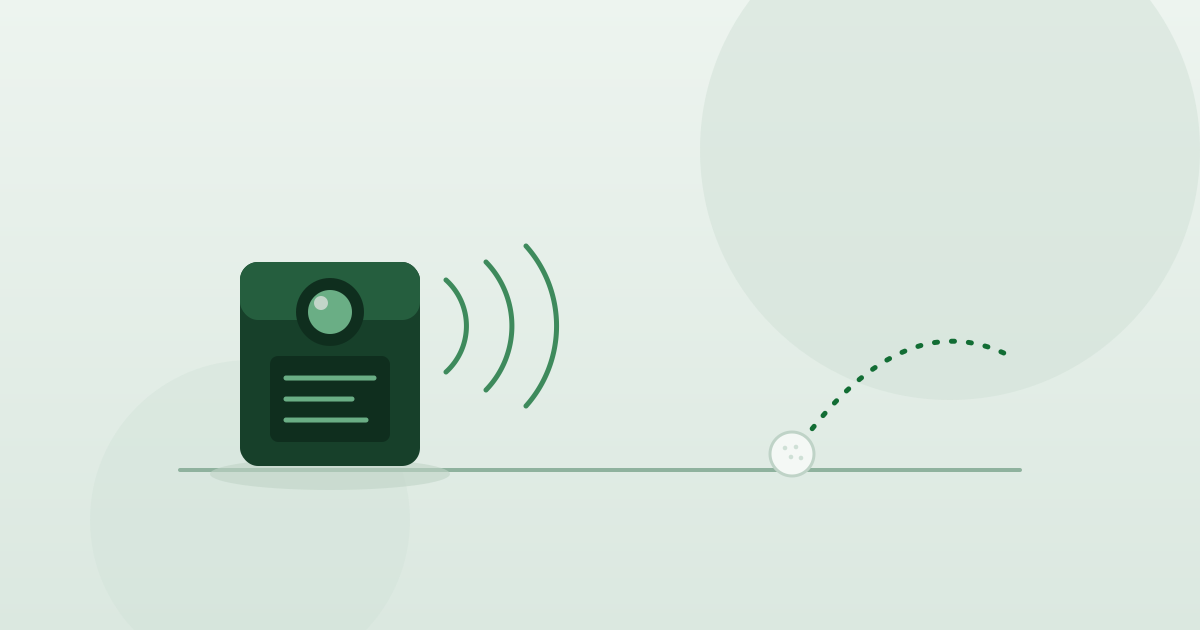
Trackman works by using radar to track your club and the golf ball at impact, then converting those measurements into a realistic ball flight on screen. It sends out a radar signal, reads how the moving club and ball change that signal, and calculates numbers like speed, launch angle and spin, which the simulator software uses to land your shot on a virtual hole. In short: the radar measures the shot you actually hit, and the software draws the rest.
That sounds technical, but you never touch any of it — you make a normal swing and the system does the work in a fraction of a second. Understanding the basics, though, helps you read venue listings, judge whether a setup is well built, and trust the numbers you see on screen. This guide walks through what Trackman is, how it senses your shot indoors, what it measures, and how all of that becomes a playable round you can enjoy.
- Trackman is built around Doppler radar, which tracks the club and ball while they are moving.
- Indoors, the radar reads the strike and launch just after impact, then the software models the rest of the flight.
- Many indoor units add a camera alongside the radar for extra precision in a short space.
- The measured numbers run through a ball-flight model that lands your shot on the virtual hole.
- How accurate a bay feels still depends on calibration and the quality of the setup around it.
What is Trackman?
Trackman is one of the best-known names in launch monitors and golf simulators. A launch monitor is the sensor that measures your club and ball, while a simulator wraps that sensor in software, a screen and a hitting bay so you can play virtual courses. Trackman built its reputation on radar tracking outdoors, following the full flight of the ball down the range, and the same core technology now powers indoor simulator bays. That heritage is a big part of why it is so widely trusted by coaches and fitters. You can see how it sits alongside other systems in our simulator technology guide.
How does Trackman measure your shot?
Trackman uses Doppler radar. It continuously emits a radar signal and measures how that signal shifts as your club swings through impact and the ball launches away. From those shifts it works out the movement of both the club and the ball, measuring the strike rather than estimating it from a single snapshot. Because radar tracks objects in motion, it reads the club coming into the ball and the ball leaving it as one continuous picture, which is its real strength. That is the same principle used to track full ball flight outdoors, scaled down to fit the space of an indoor bay without losing the thread of the shot.
How does Trackman work indoors in a simulator bay?
Indoors there is no room for the ball to fly its full distance, so the radar reads the launch just after impact and the software models the rest of the trajectory. To stay precise in that short space, many indoor Trackman setups pair the radar with a camera, combining what the radar measures in motion with what a camera sees at the exact moment of impact. The unit is positioned around the hitting area so it has a clear, unobstructed view of the club and ball. A well-placed, well-calibrated unit is a large part of why one bay can feel sharper than another running the very same hardware.
What does Trackman measure?
Trackman reports a full set of numbers describing both the club and the ball, and every one is measured rather than guessed. The exact list depends on the specific model and how the bay is set up, but the readings fall into three broad groups that together describe the whole shot. Our data guide explains what each number means in plain English, so the screen stops looking like an intimidating wall of statistics and starts giving you something useful to act on, whether you are fitting a club or grooving a swing change.
- Club delivery — how fast the club is moving and the direction it travels through impact, including club speed and club path.
- Ball launch — ball speed, launch angle and spin rate, which together decide how the shot flies.
- Results — the modelled carry distance and where the ball finishes on the virtual hole.
How does Trackman turn measurements into a shot on screen?
Once the radar — and the camera, where one is fitted — has measured your strike, Trackman's software runs those numbers through a ball-flight model and lands the shot on the virtual hole. The model applies the physics of how a real golf ball flies, so a well-struck shot climbs, curves and rolls out the way it would outdoors. The same measured data drives full-course rounds, the practice range and structured practice modes, which means the experience stays consistent whatever you choose to do. We cover the most popular options in the best Trackman modes to try.
Is Trackman accurate?
Radar launch monitors like Trackman are widely used for club fitting, coaching and tour-level practice, so for everyday play and improvement the numbers are reliable enough to act on with confidence. As with any simulator, how accurate a given bay feels depends on how the unit is calibrated and the quality of the setup around it, from the mat to the screen distance. A great sensor in a poorly tuned room can still disappoint, and a carefully set-up bay can feel superb. We go deeper into what accuracy really means in are golf simulators accurate? and specifically in how accurate is Trackman?.
How is Trackman different from camera-based simulators?
The main divide between simulator systems is how they see the shot: radar units like Trackman track objects in motion, while camera-based units photograph the ball at the moment of impact. Each approach has trade-offs in where the unit sits and what it reads best — radar likes a little distance to watch the ball move, while cameras capture everything right at contact and fit comfortably into tighter rooms. Neither is universally better; the right choice often comes down to the space and how well the unit is installed. We compare the two approaches in plain English in radar vs. camera launch monitors.
Do you need your own clubs to play Trackman?
No — you play a standard golf ball with normal clubs, so there is nothing special to bring. Many venues provide balls, and some offer loaner clubs too, so it is worth checking your venue's listing before you book. Using your own set does have one upside: the data then reflects the exact clubs you actually play, which matters if you are mapping your distances or fitting gear. If you are new to the experience, bringing nothing and renting on site is a perfectly good way to start. Our guide on whether you need your own clubs covers the trade-offs in detail.
Ready to try it yourself? Browse simulator venues near you and look for the launch monitor each venue runs before you book, then check the reviews to see how the bay actually plays day to day.