Launch Monitors vs Golf Simulators: What's the Difference?
They get used interchangeably, but a launch monitor and a full simulator are not the same thing. Here's how they relate.
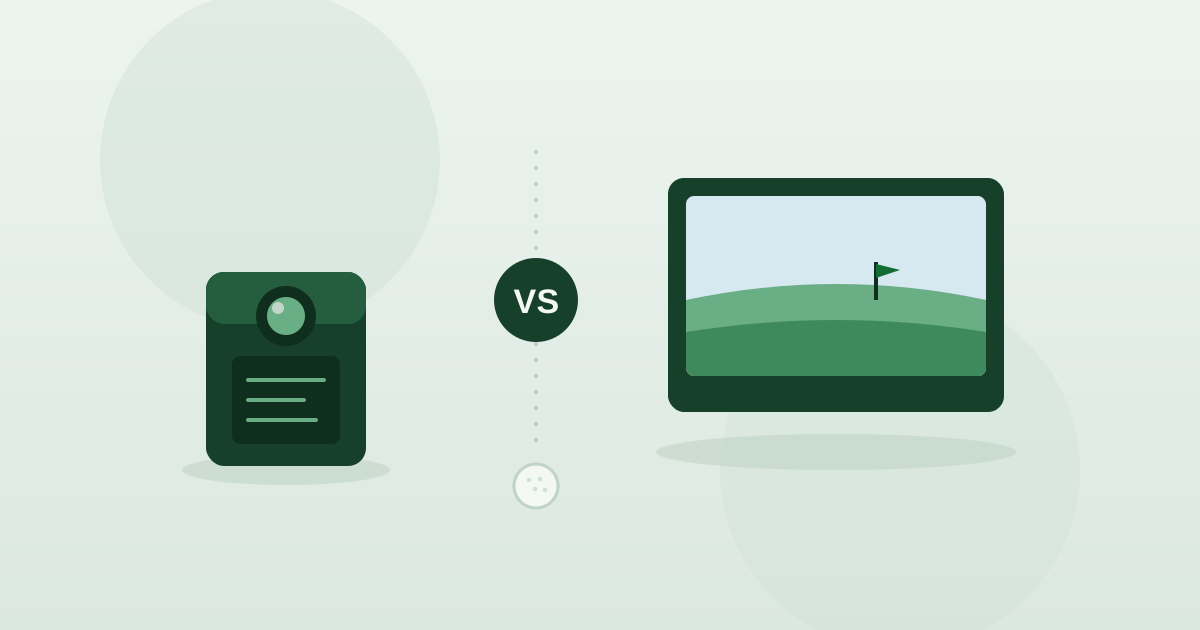
A launch monitor is the sensor that measures your club and ball at the moment of impact and reports the numbers; a golf simulator wraps that same sensor in software, a screen and a hitting bay so you can actually play virtual courses. Put simply, every simulator contains a launch monitor, but a launch monitor on its own is a practice and data tool rather than a course you can play. The distinction sounds small, yet it quietly shapes where you choose to play, what you might one day buy, and how you read a venue listing.
The two terms get used interchangeably because they overlap so much — the launch monitor is the part doing the measuring inside every simulator, so people reach for whichever word comes to mind. Knowing where one ends and the other begins, though, makes product pages, reviews and venue listings far easier to decode. This guide walks through what each does, how they differ for practice and play, and how to tell which one a venue is really offering before you book a bay.
- A launch monitor is the sensor; a simulator is that sensor plus software, a screen and a bay.
- Every simulator contains a launch monitor, but not every launch monitor is set up as a simulator.
- Launch monitors are about data and practice; simulators are about playing virtual courses.
- The launch monitor model shapes accuracy either way, so it is worth knowing which one you are using.
- For social rounds you want a full simulator; for focused numbers a launch-monitor bay may be enough.
What does a launch monitor actually do?
A launch monitor is the sensor at the heart of the whole experience. Its job is to watch your club and ball through impact and report figures like ball speed, spin rate and launch angle, then estimate how far and where the ball would fly. On its own it is a practice and fitting tool — it hands you data and a clear sense of your distances, but it does not give you a virtual course to play around. That makes a standalone monitor popular for deliberate practice, for tracking progress over time, and for comparing one club against another purely by the numbers rather than by feel.
What does a golf simulator do?
A golf simulator takes that same launch monitor and builds an experience around it — software, a projector or screen, and a hitting bay — so you can play full rounds on virtual courses, take on games and challenges, and watch your shot rendered in three dimensions. The sensor still does the measuring; the software adds the course, the graphics and the scorekeeping on top. This is what most people picture when they imagine indoor golf: stepping into a bay, picking a famous course, and playing it with friends no matter the weather outside. Our guide to how simulators work covers the full setup in plain English.
Is a launch monitor or a simulator better for practice?
Both can sharpen your game; they simply suit different sessions. A launch monitor — or a simulator running in range mode — is excellent for deliberate practice, hitting the same shot over and over while you watch the numbers settle. A full simulator adds the value of playing actual holes, which tests course management, club selection and nerves in a way a flat range never can. Many golfers happily use both, and you can mix them within a single visit if a venue supports it. If practice is your focus, our guide on how to practise on a simulator goes deeper.
- Use a launch monitor or range mode to repeat one shot and read the data.
- Use a full simulator to test club selection and nerves on real holes.
- Pair the two: groove a change on the range, then play a round to confirm it.
- A driving range mode bridges both for warm-ups and drills.
Why is a launch monitor better for club fitting?
When the goal is to compare clubs rather than play a round, the raw numbers matter most, and that is exactly what a launch monitor delivers. A fitter can have you hit several options back to back and watch how each one changes your carry, your spin and your shot dispersion, then read the differences directly from the data. A full virtual course is beside the point here — you want a controlled setting and clean readings, not a fairway to navigate. That is why many fitting bays lean on a launch monitor first and foremost. Our overview of club fitting explains what a session involves and what to look for.
How do radar and camera systems differ?
The two main ways a launch monitor reads your shot are radar and camera-based optics, and the difference is part of why systems can feel distinct. Radar units track the ball and club in flight, while camera systems photograph them at impact at very high speed; some setups combine both approaches. Each method has its strengths in different conditions, which is one reason two venues running different technology can play noticeably differently. You do not need to master the engineering, but it helps to know the broad camps. Our radar vs camera guide compares them, and the technology overview lists the common systems you will meet.
Does the difference matter when choosing a venue?
It does, because it determines what you can actually do once you arrive. If you want to play courses with friends, look for a venue running a full simulator setup; if you mainly want practice data or a fitting, a launch-monitor-focused bay may be all you need. Either way the underlying sensor still shapes accuracy, so it is worth knowing which model a venue runs. Listings here show the technology, and recent reviews fill in the feel that specs alone cannot capture.
- For social rounds, choose a venue advertising full simulator play.
- For numbers and fitting, a launch-monitor bay may be plenty.
- For coaching, look for a venue offering instruction.
- Whichever you pick, check the sensor model and reviews — or browse by technology.
Can you have a simulator without a launch monitor?
Not really — the launch monitor is the component that makes the whole thing work. Without a sensor measuring your strike, the software would have nothing to turn into a ball flight, so there would be no realistic shot to render and no score to keep. You can certainly have a launch monitor without a simulator, using it purely for data on a range or in a fitting, but the reverse does not hold. Thinking of it this way clears up most of the confusion: the simulator is the experience, and the launch monitor is the engine quietly powering it from underneath on every single shot you hit.
Want to see what is near you? Browse venues and check each listing's technology, or open the map to compare locations at a glance before you book.