What Is Face Angle on Trackman?
What face angle means on a Trackman, how it is measured at impact, and why it matters more than almost any other number for where your ball starts.
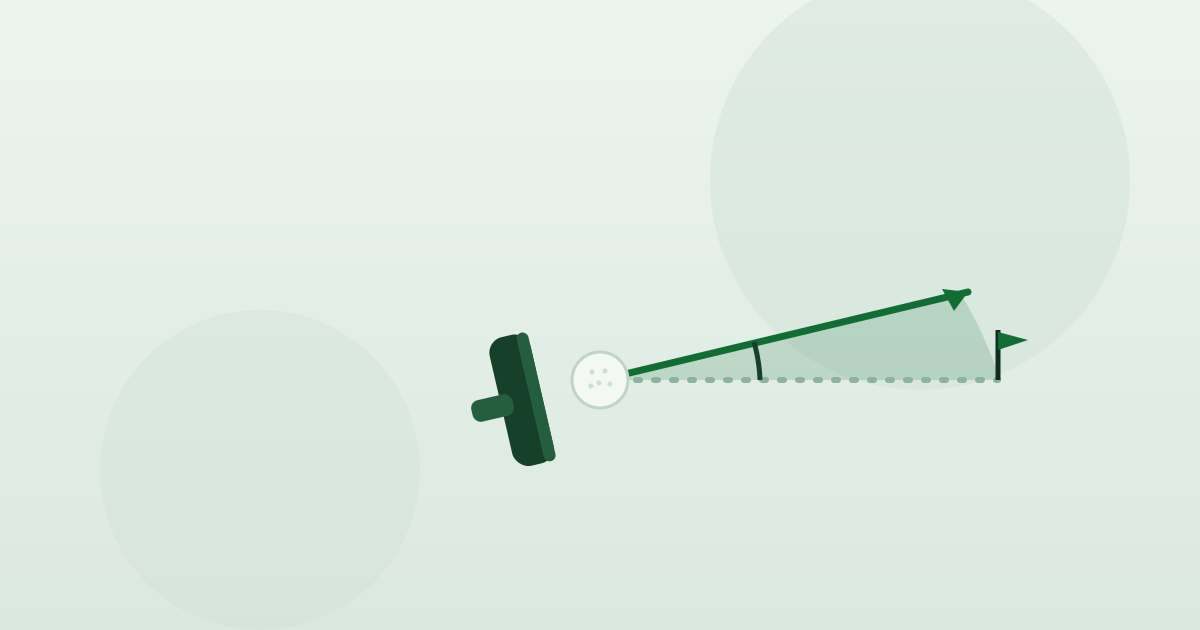
Face angle is the horizontal direction the clubface is pointing at the moment it meets the ball, measured against your target line. Trackman reports it as open, closed or square. For a right-handed golfer, an open face points to the right of the target, a closed face points to the left, and a square face points straight down the line you are aiming at. The reason this number sits near the top of every Trackman report is simple: more than any other measurement, the direction the face is pointing at impact decides where your ball begins its journey.
It is easy to confuse face angle with club path or with where you aimed at address, but they describe different things, and understanding the difference is the key to reading your shot shape. This guide explains what face angle is, how Trackman measures it, and how to use it, without quoting specific values, since the right face angle depends on your club, your target and the shot you are trying to hit.
- Face angle is where the clubface points at impact, relative to the target line, and shows up as open, closed or square.
- It is the dominant factor in where the ball starts its flight.
- Combined with club path, it decides whether the ball draws, fades or flies straight.
- It is read at the instant of impact, not at address or at the top of the swing.
What does face angle mean on Trackman?
Face angle is the horizontal direction the clubface is pointing at the instant it meets the ball, measured against your target line. Trackman reports it as open, closed or square. For a right-handed golfer, an open face points to the right of the target, a closed face points to the left, and a square face points straight down your aim line; left-handed players simply mirror those directions. The reason this number sits near the top of every Trackman report is that, more than any other measurement, the way the face points at impact decides where your ball begins its flight.
How does Trackman measure face angle?
Trackman tracks the clubhead through impact and measures where the face is pointing at the instant of contact, rather than guessing from your setup or the rest of your swing. That matters because the face can change a great deal in the fraction of a second around impact, so a reading taken at any other moment would mislead you. Measuring it directly is part of what separates a serious launch monitor from a simpler one. For the bigger picture of how the system follows your club and ball, see how does Trackman work? and radar vs. camera launch monitors.
Open, closed, or square: what is the difference?
These three words describe the same number from the golfer's point of view. A square face is aimed at your target line at impact and tends to start the ball on line. An open face is aimed away from you, to the right for a right-handed player, and tends to start the ball out in that direction. A closed face is aimed across your body, to the left for a right-handed player, and tends to start the ball that way. Left-handed golfers mirror those directions. None of these is automatically right or wrong; what matters is whether the face angle is the one you intended for the shot you are trying to hit.
How does face angle affect ball flight?
Face angle does two jobs at once. First, it sets where the ball starts, because the ball leaves roughly in the direction the face is pointing. Second, together with the path of the club, it decides which way the ball curves in the air. When the face points in a different direction from the path, the ball spins on a tilted axis and curves; when the face and path agree, the ball flies much straighter. That curvature shows up on Trackman as the ball's spin axis, and you can read about every related number in the launch monitor data guide.
Face angle vs. club path: what is the difference?
This is the distinction that unlocks shot shape. Face angle is where the clubface points at impact; club path is the direction the clubhead is travelling through impact. The face mostly controls where the ball starts, and the relationship between the face and the path mostly controls how it curves. Trackman even reports that relationship directly as face to path, so you do not have to do the subtraction yourself. Keeping these two ideas separate in your head is the single biggest step toward understanding why a shot did what it did.
What is a good face angle?
There is no universal number, because the right face angle depends on the shot you want. If you are trying to start the ball straight at your target, a square face is the goal. If you are working a draw or a fade on purpose, you will want the face open or closed by an amount that suits that shape, relative to your path. A face that points where you intended is a good face angle, full stop. Rather than chasing one value, use Trackman to confirm that your face is doing what you meant it to, shot after shot, and check it against how accurate is Trackman? so you trust what you are reading.
How can I use face angle to fix my shots?
Most crooked shots make sense the moment you read the face. A ball that starts well offline usually points to a face that was open or closed at impact, while a ball that starts on line but curves away points more to the gap between your face and your path. Watching the number over a series of swings tells you whether the issue is consistent or random, which is the first step to fixing it. Our guide on how to use simulator data to fix your swing walks through turning these readings into practice you can act on.
Where can I see face angle in action?
You do not need to own a launch monitor to learn from your face angle; any venue running Trackman will put the number in front of you in real time. Seeing it react to small changes in your grip and setup is far more useful than reading about it. To try it for yourself, start with our list of Trackman venues, or browse simulators near you and check the technology noted on each listing before you book.
Want to watch your own face angle change in real time? Find a Trackman venue near you or browse every nearby bay, and check which launch monitor each one runs before you book.