What Is an Up and Down in Golf?
An up and down means getting the ball in the hole in two shots from off the green — one chip or pitch, one putt. Here is why it matters for scoring.
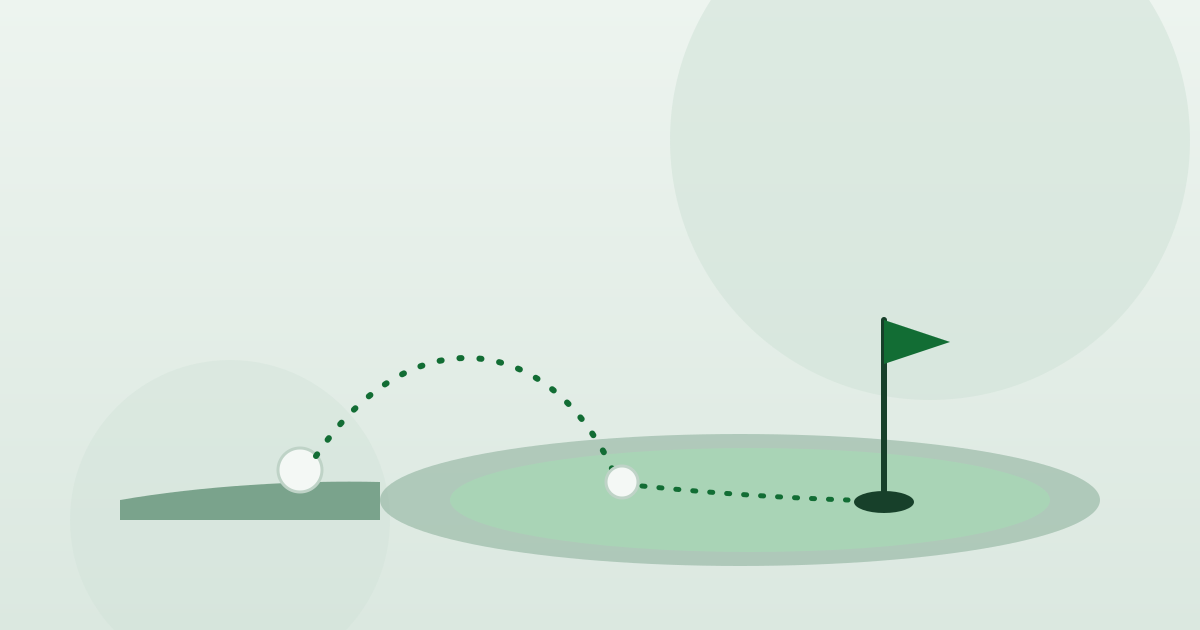
An up and down is completing the hole in exactly two shots from off the green: one shot up onto the putting surface (a chip, pitch or bunker shot) and one putt down into the hole. Miss a green, get up and down, and you have rescued your score as if the approach had never gone wrong — which is why short-game players seem to make par out of thin air.
The phrase is everywhere in golf commentary and post-round storytelling, and it drags a small family of slang with it — sand saves, sandies, scrambling percentages. This guide defines them all, explains why the up and down is arguably the amateur game's biggest scoring lever, and covers how to raise your own conversion rate, including what simulators can and cannot practice.
- Up and down = one shot from off the green onto it, plus one putt in.
- From a bunker, a successful up and down is a sand save (or sandy).
- The stat scrambling measures how often you save par after missing a green.
- Amateurs miss most greens, so up-and-down skill decides most scores.
- One dependable chip beats five spectacular ones.
What does up and down mean exactly?
Two shots, strictly: the up gets the ball from off the green onto it, and the down is a single putt that finds the hole. Chip to three feet and hole the putt — up and down. Chip on and two-putt: not an up and down, however tidy the bogey. The phrase is most often used about saving par, but it applies to any score — you can get up and down for birdie after a great drive on a short hole, or for bogey to dodge a triple. What it always signals is a short game that closed the deal in the minimum two strokes.
What is a sand save, and what is a sandy?
A sand save is an up and down executed from a greenside bunker — splash out, one putt, hole finished. Sandy is the casual, betting-game name for the same feat, and in many friendly formats a sandy earns a point or a payout on its own. It is tracked separately from ordinary scrambling because bunker escapes are harder: sand adds variables that grass does not, as anyone who has met a fried egg lie can testify. If you keep one short-game stat for bragging rights, sand-save percentage is the connoisseur's choice.
Why do up and downs matter so much for scoring?
Because missing greens is the normal condition of amateur golf. Even competent club golfers miss more greens than they hit, which means the up-and-down opportunity appears constantly — often a dozen or more times a round. Convert a few extra of those and your score drops by strokes without your swing improving at all; that is the entire pitch for short-game practice. The stat golf calls scrambling (the percentage of missed greens you still save par on) is, for most amateurs, a better predictor of a good scoring day than driving distance will ever be.
How do you improve your up-and-down rate?
Simplify, then repeat. Most conversions come from ordinary chips, so build one dependable, low-risk shot — many teachers suggest a simple bump-and-run with a favourite club — and use it whenever the ground allows, saving high, spinny pitches for when something must be carried. Aim the chip at a realistic circle, not the pin. And practice the three-to-six-foot putts that finish the job, because the down half fails as often as the up. Distance control, not flair, converts up and downs; our how to swing a golf club guide covers the foundations underneath it.
Can you practice up and downs on a simulator?
Partially, and it is worth knowing which part. Simulators measure chip and pitch carry distances well, which trains the up half's distance control — hugely valuable, since most chips miss long or short, not left or right. Putting on simulators varies more by venue and system, and reading real grass breaks remains an outdoor skill; our guides to simulator putting and short game accuracy and simulator vs putting green practice give the honest picture. For wedge-distance calibration alone, an indoor bay earns its keep — find a venue near you and bring your wedges.
Working on your short game? Read simulator putting and short game accuracy, brush up on the dreaded fried egg lie, or find an indoor practice venue near you.