What Degree Is an Approach Wedge?
What degree is an approach wedge? Most approach wedges are 50 to 52 degrees of loft — it is another name for a gap wedge. Here is how it fits your set.

What degree is an approach wedge? An approach wedge is typically 50 to 52 degrees of loft, sitting right between your pitching wedge and your sand wedge. If that sounds familiar, it should — an approach wedge is another name for a gap wedge (sometimes stamped with an A or a G), and it fills the distance gap that opened up as pitching wedges were made stronger over the years. As always, the exact loft varies by manufacturer and set, so check the number stamped on your own club.
Because it goes by more than one name, the approach wedge causes a fair bit of confusion. This guide clears it up: what loft an approach wedge usually is, why it shares a name with the gap wedge, how it fits with your other wedges, and how a golf simulator or launch monitor shows the real distances so your gaps stay even.
- An approach wedge is usually 50 to 52 degrees of loft.
- It is another name for a gap wedge, often stamped A or G.
- It sits between the pitching wedge and the sand wedge.
- Aim for even loft gaps of about 4 to 6 degrees between wedges.
- A launch monitor shows the real carry distances so you can spot uneven gaps.
What is the typical loft of an approach wedge?
An approach wedge usually falls between 50 and 52 degrees, the same range you will see quoted for a gap wedge. It splits the difference between a pitching wedge (often around 44 to 48 degrees) and a sand wedge (often around 54 to 58), so no single distance is left uncovered. A few manufacturers place theirs slightly outside that band, and because lofts are not standardized, the surest way to know yours is to read the number printed on the club.
Is an approach wedge the same as a gap wedge?
For practical purposes, yes. Approach wedge, gap wedge, A-wedge and G-wedge all describe the same club — the one that fills the gap between the pitching wedge and the sand wedge. The name simply depends on the manufacturer: some stamp an A for approach (or attack), others a G for gap, and many just print the loft. If you are comparing clubs, focus on the loft number rather than the letter, since that is what determines how far the club carries. For the same club under its other name, see what degree is a gap wedge.
How do you choose the right approach wedge loft?
If you are buying, an approach wedge around 50 to 52 degrees usually spaces cleanly between a modern pitching wedge and a 56-degree sand wedge. But many golfers already own an approach wedge as part of their irons, and in that case the more useful step is to read its stamped loft and check the gaps on either side rather than assume. If the jump from your pitching wedge to your approach wedge is much bigger or smaller than the jump on to your sand wedge, the spacing is off, and tweaking a loft or swapping one wedge will even it out.
- Read the loft stamped on your approach wedge first.
- Compare its gap to the pitching wedge and to the sand wedge.
- Uneven jumps mean a loft tweak or a wedge swap is due.
- Aim for roughly 4 to 6 degrees between neighbouring wedges.
How does an approach wedge compare to other wedges?
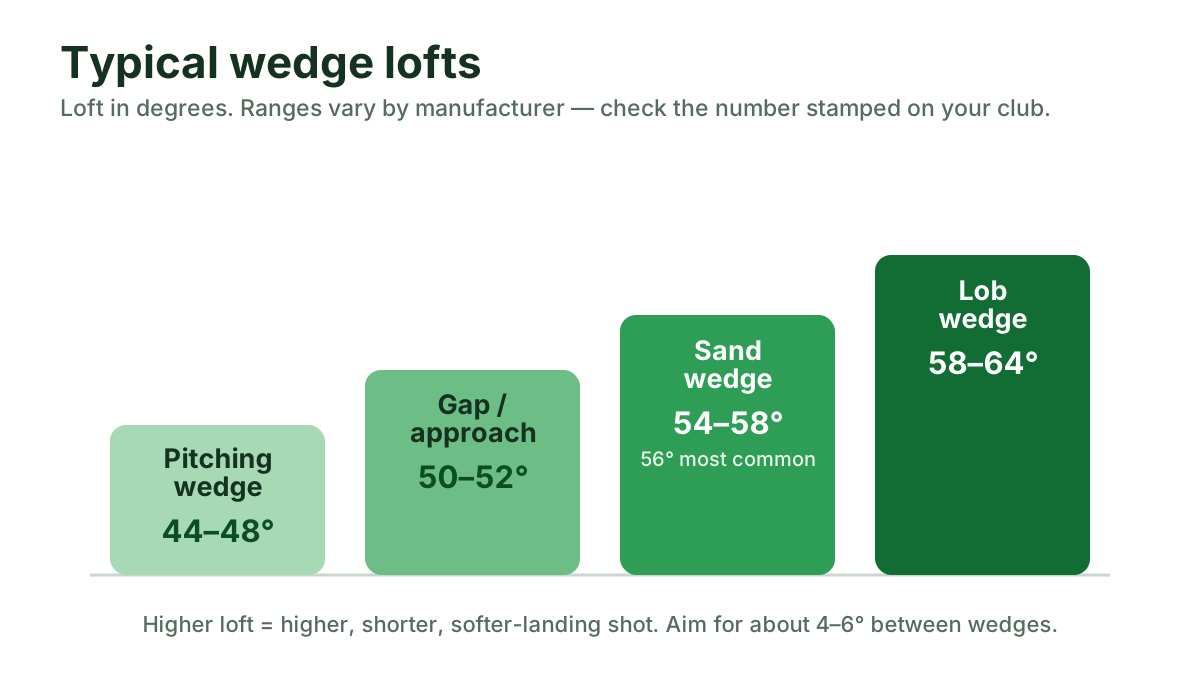
In a typical set, the wedges run pitching, approach (or gap), sand, then lob, each with more loft than the last. The pitching wedge is usually around 44 to 48 degrees, the approach or gap wedge around 50 to 52, the sand wedge around 54 to 58, and the lob wedge around 58 to 64. Each step up in loft gives a higher, shorter, softer-landing shot, which is why most players carry two or three of these to cover the scoring range.
- Pitching wedge — typically about 44 to 48 degrees.
- Approach / gap wedge — typically about 50 to 52 degrees.
- Sand wedge — typically about 54 to 58 degrees.
- Lob wedge — typically about 58 to 64 degrees.
How can a golf simulator help you set your wedge gaps?
A stamped loft only predicts distance; it does not measure it. Hitting a few shots with each wedge on a golf simulator or launch monitor shows the real carry for your pitching wedge, approach wedge and sand wedge side by side, so you can see whether the yardages step down evenly. The common surprise is an approach wedge that carries almost as far as the pitching wedge — a clear sign the lofts sit too close together. Our metrics guide explains what to look for, and you can find a simulator near you to measure your own wedges.
Ready to check your yardages? Find an indoor golf simulator near you, see what a launch monitor measures, or read what degree is a gap wedge and what degree is a sand wedge to complete the wedge picture.