Golf Simulator Ceiling Height Guide
No single ceiling height guarantees simulator clearance. Check the golfer, clubs, stance mat, obstructions and equipment mounting requirements.
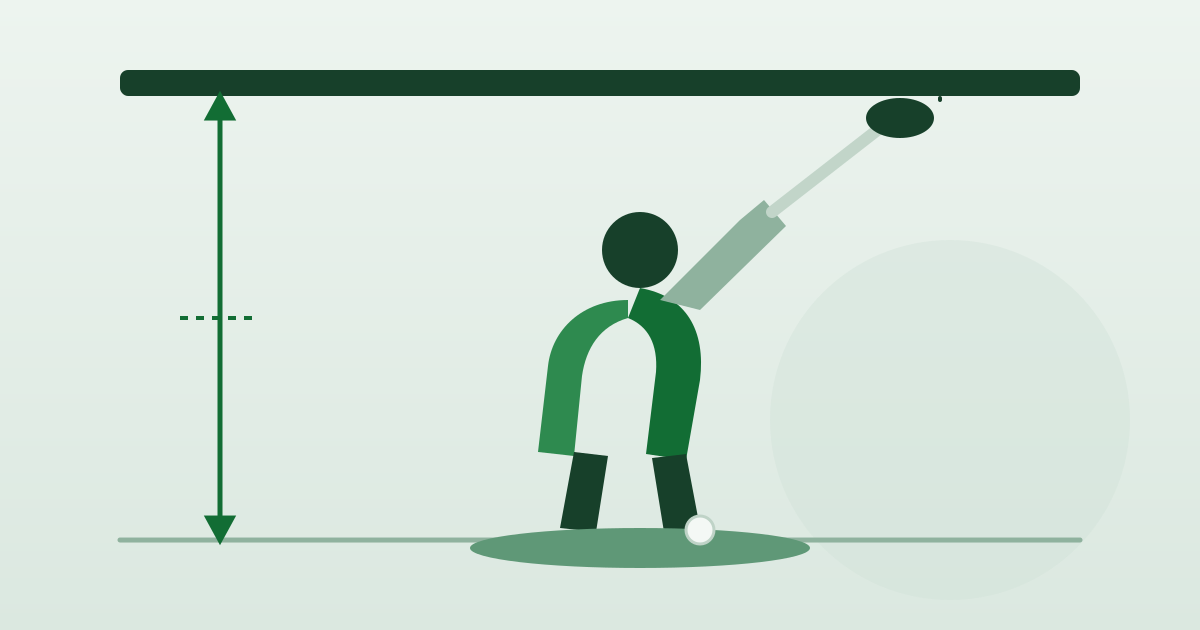
There is no single ceiling height that guarantees a golf simulator will be safe for every golfer. Nine to ten feet is a common planning range, not a clearance certificate. Check every intended player's swing, clubs, stance surface, overhead obstructions and equipment installation requirements. An eight-foot ceiling does not automatically make even an irons-only setup suitable.
This guide separates golfer clearance from enclosure and electronics mounting requirements. Use it before buying a kit; neither a room-size calculator nor an advertised minimum height can inspect your particular swing or room.
- Nine to ten feet is a planning reference, not a guarantee.
- Do not assume an eight-foot room is suitable even for shorter clubs.
- Assess the whole swing envelope; never test uncertain clearance at full speed.
- Mats raise you closer to the ceiling; account for their thickness.
- Ask commercial venues about their specific bay, equipment and player restrictions too.
How much ceiling height do you need for a golf simulator?
Treat commonly quoted nine- or ten-foot heights as starting points. A longer club, a different finish, a raised mat or a hanging fixture can change the result. An enclosure fitting under the ceiling says nothing about whether all intended golfers can swing inside the installed setup. Equipment minimum heights and safe player clearance are separate checks.
How do you test your own space?
Measure first, with no ball in play, and identify every obstruction across the backswing and finish. Account for the intended shoes and a stable finished stance surface; do not balance on improvised platforms. Only assess slow controlled club movement where there is already ample clearance, and keep other people outside the movement area. A slow rehearsal cannot prove a full-speed swing will clear. If there is any doubt, stop and seek an on-site assessment rather than swinging harder to find out.
What changes how much height you need?
Player height, club length and swing shape all affect the space used. Check each intended club: the longest club alone does not prove every other swing will clear. A raised stance mat reduces available overhead clearance, and different hitting positions may bring beams or fixtures into the swing path. Include left- and right-handed players if both will use the room. Borderline clearance is a reason to stop, not to rely on repeating a restrained rehearsal.
What if your ceiling is too low?
Consider a different room, a properly assessed shorter-club setup, or using a commercial venue. Do not rely on gaps between joists, change your normal swing to dodge an obstruction, or alter structural members without qualified advice. Shorter clubs still need their own clearance assessment. For width and depth planning, see home golf simulator space.
How do commercial venues solve ceiling height?
A commercial bay may provide more space, but being a commercial venue does not guarantee clearance for every player. Ask staff about the specific bay, permitted clubs, hitting position and any overhead restrictions before playing. Compare home ownership with using a venue, or find a venue near you and confirm suitability with its operator.
Measure usable clearance, not just floor-to-ceiling height
| Check | What to measure | Why it matters |
|---|---|---|
| Golfer and clubs | Every intended player's backswing and finish, with each intended club | Height alone cannot predict the swing envelope. |
| Finished hitting surface | Clearance above the stance mat, including shoes and any raised platform | A 108-inch room with a 2-inch platform leaves 106 inches above that surface, before overhead obstructions. |
| Lowest obstruction | Beams, lights, fans, door tracks, projector and launch-monitor mounts | The lowest object in the swing path matters more than the highest part of the ceiling. |
| Hardware envelope | Actual frame dimensions, assembly clearance and the exact monitor's mounting range | A frame fitting inside a room does not establish safe swing clearance. |
The Indoor Golf Shop describes 9 feet as suitable for an average golfer in its DIY guidance, but explicitly makes this dependent on the golfer and swing. That is a planning reference, not a safety certification. Carl's Pro enclosure guidance separately calls for at least 2 inches above the frame for assembly. Neither number replaces the other.
Use the calculators in the right order
Start with the room-size calculator to compare a proposed layout, then use the projector calculator with the usable image width, not the enclosure's outside width. Neither calculator certifies safe swing clearance or checks a specific mount. Compare enclosures and impact screens only after checking the room and the exact equipment manuals.
This is a manufacturer-sourced planning guide, not an on-site assessment or hands-on product test. Stop if clearance is uncertain; do not use full-speed swings to discover an obstruction.
Planning an indoor setup? Read how much space a home golf simulator needs, weigh it against going to a venue, or find a venue near you and ask about its bay dimensions.